If you live in New York, you know that “relaxed” isn’t exactly our default state. Between the subway delays, the noise, and the hustle, switching off at the end of the day can feel like a job in itself.
For decades, legacy operators and long-time smokers have known that high-THC numbers aren’t the only thing that matters when you’re trying to unwind. You need the full profile of the plant. Enter myrcene.
Myrcene (pronounced mer-seen) is the most abundant terpene found in modern cannabis. According to data from Leafly, myrcene represents over 20% of the terpene profile in most commercial strains. It is the “Mother of All Terpenes,” the heavyweight champion of relaxation, and the primary reason why certain strains glue you to your couch while others make you want to clean your apartment. If THC is the gas pedal of your high, myrcene is the comfortable leather seat that makes the ride enjoyable.
In this guide, we are going to break down exactly what myrcene is, why it smells so familiar, the truth about the “mango myth,” and why choosing full-spectrum flower or vapes is the only way to truly experience it.
The Vibe Check: What Does Myrcene Actually Do?
You will often see cannabis categorized simply as “Indica” or “Sativa,” but those terms are surprisingly outdated. The real magic lies in the terpenes. Myrcene is the primary terpene associated with the “Indica” effect—that heavy, body-centric sensation that melts tension.
The Science of Sedation
When we talk about “couch-lock,” we are talking about myrcene. Research published in PubMed has highlighted myrcene’s potential as a sedative and muscle relaxant, noting that it increased sleep duration in animal studies. It is the compound that tells your body it is time to stop moving and start resting.
In the legacy market, we didn’t always have lab tests, but we knew by the smell. If a bag smelled heavy, musky, and deep, we knew it was a “nighttime” strain. That was the myrcene talking. It works synergistically with THC to produce a heavier, more physical high than THC could achieve on its own. If you are struggling to sleep or can’t get your shoulders to drop away from your ears after a long week, you are likely looking for a high-myrcene strain.
The Entourage Effect: Opening the Door
This is where the science gets really cool. The “Entourage Effect” is the theory that cannabis compounds work better together than they do alone. Myrcene is the MVP of this team.
According to a landmark study in the British Journal of Pharmacology, terpenes like myrcene may help modulate the effects of THC. There is evidence to suggest that myrcene may help increase the permeability of the blood-brain barrier. Think of the blood-brain barrier as the bouncer at the club. Myrcene slips the bouncer a twenty, opening the door wider so that cannabinoids like THC can enter your system more easily and effectively. This is why a strain with 20% THC and high myrcene might feel significantly more potent than a strain with 28% THC and low terpenes. The myrcene is maximizing the efficiency of the THC.
Pain Relief and the Body High
Beyond just making you sleepy, myrcene has been studied for its potential analgesic (pain-relieving) properties. Studies found in the National Library of Medicine suggest myrcene possesses anti-inflammatory and anti-nociceptive (pain-blocking) effects, making it a target for natural pain management. For medical patients or just anyone with a bad back from standing on the L train all day, myrcene-dominant strains provide that physical relief that feels like a warm blanket.
Sniff Test: What Does Myrcene Smell and Taste Like?
You have definitely smelled myrcene before, even if you’ve never smoked a day in your life. It is naturally found in hops, lemongrass, thyme, and mangoes.
In cannabis, myrcene presents a very specific, recognizable profile:
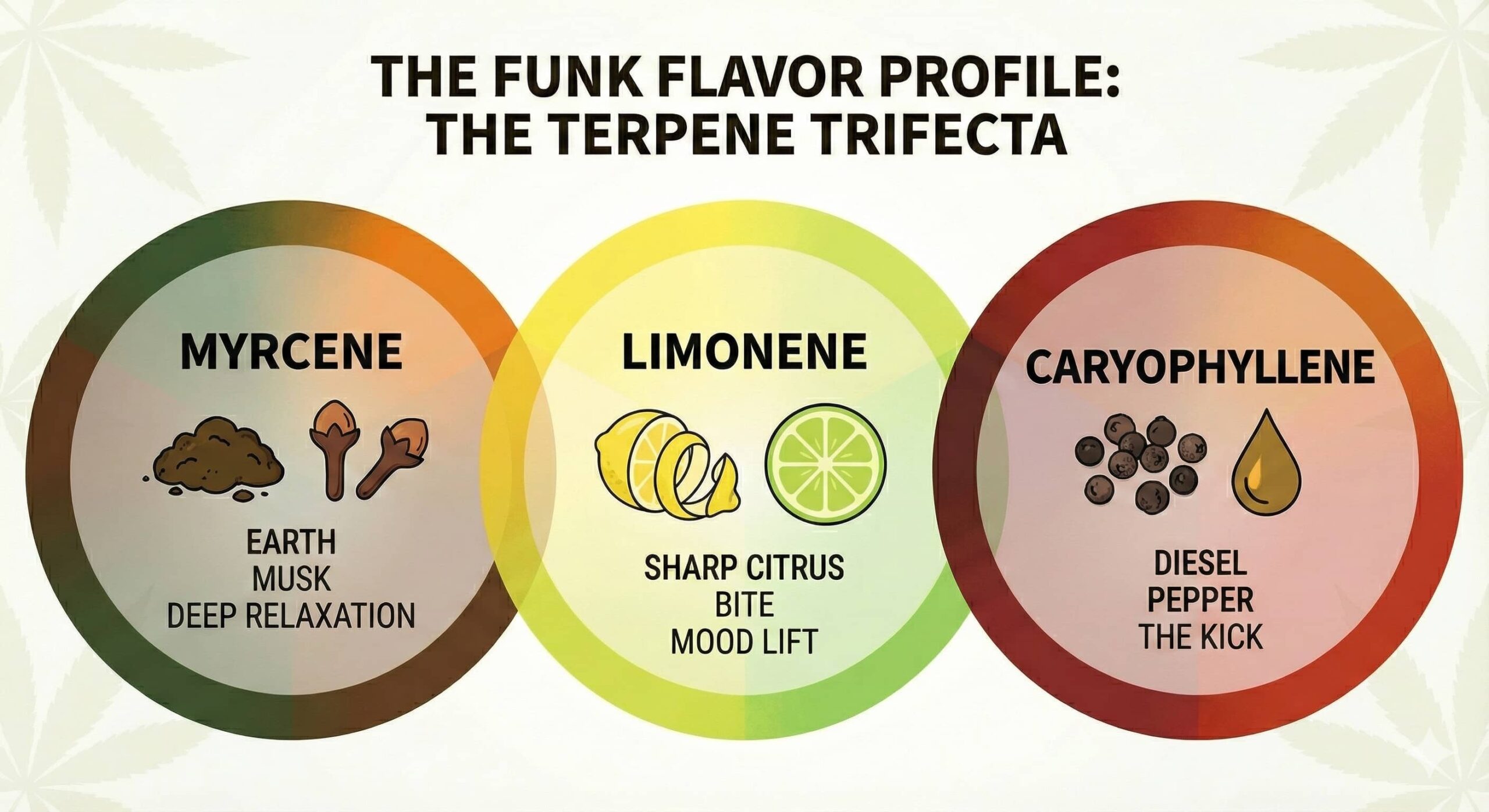
- Aroma: Earthy, musky, herbaceous, and sometimes slightly clove-like. It smells like damp soil, autumn leaves, or a spice cabinet.
- Flavor: It often translates to a “balsamic” or spicy taste on the exhale, sometimes with hints of ripe fruit.
If you crack open a jar of flower and it hits you with that dank, funky, deep earth smell, you are almost certainly holding a high-myrcene strain. It lacks the sharp sting of pine (pinene) or the bright zest of citrus (limonene). It is a grounded, heavy scent.
Terpene Profile Comparison
Here is how myrcene stacks up against the other major players you’ll see on New York menus.
| Terpene | Aroma Profile | Primary Effect | Found In |
| Myrcene | Earthy, Musky, Clove | Sedation, Relaxation, “Couch-Lock” | Hops, Mango, Thyme |
| Limonene | Citrus, Lemon, Orange | Mood Elevation, Stress Relief | Lemon Rind, Juniper |
| Pinene | Pine Needles, Sharp | Alertness, Memory Retention | Pine Trees, Rosemary |
| Caryophyllene | Pepper, Spicy, Wood | Pain Relief, Anti-Anxiety | Black Pepper, Cloves |
The Mango Myth: Can Fruit Actually Boost Your High?
If you hung around stoners in Washington Square Park back in the day, you definitely heard this legend: “Eat a mango 45 minutes before you smoke, and you’ll get higher.”
Is it true? Or is it just bro-science?
The answer is a little bit of both. The theory is sound. Mangoes are incredibly rich in myrcene. The idea, supported by the British Journal of Pharmacology’s discussion on terpene synergy, is that by loading your system with myrcene from the fruit, you prep the blood-brain barrier to accept more THC.
The Reality:
While the chemistry holds up on paper, the metabolism is tricky. Your body digests food differently than it absorbs smoke. However, many smokers swear by it. At the very least, a ripe mango is a delicious cure for cottonmouth. We say try it for yourself—worst case scenario, you ate a great piece of fruit.
Why “Full Spectrum” Matters for Myrcene
This is the most important part of the conversation for anyone shopping in the legal NY market right now. You have a lot of choices, and not all products are created equal. If you want the benefits of myrcene—the sleep, the pain relief, the vibe—you need to buy products that actually preserve the terpene.
Flower vs. Distillate Vapes
Cheap vape cartridges (often labeled “Distillate”) are made by stripping everything out of the plant until only the THC remains. It’s highly potent, but it’s flat. To add flavor back in, manufacturers often add “botanical terpenes” derived from other plants, not cannabis. While a distillate cart might have “myrcene” listed on the box, it often lacks the complexity of the natural plant profile found in full-spectrum products.
Full Spectrum Vapes (Live Resin/Rosin) and Flower:
These products preserve the natural ratio of cannabinoids and terpenes exactly as the plant grew them. When you smoke high-quality NY flower or a Live Resin vape, you aren’t just getting THC and isolated myrcene; you are getting the hundreds of other minor compounds that support that sedative effect.
The NugHub Rule: If you are chasing a specific feeling, like deep sleep or heavy relaxation, always prioritize Flower or Live Resin/Rosin over standard distillate. The high is richer, lasts longer, and feels more “complete.”
Top High-Myrcene Strains in New York
New York has always loved its heavy hitters. We lean toward the “gas” and the “funk.” Here are some legendary strains commonly found in local dispensaries that are famous for their heavy myrcene content, verified by Leafly strain databases.
1. Blue Dream
This might surprise you because Blue Dream is often called a “Sativa-dominant hybrid,” but it is actually packed with myrcene. The reason it doesn’t always put you to sleep is that the myrcene is balanced out by bright Pinene, creating a euphoric but relaxed body buzz. It’s a perfect example of the entourage effect in action.
2. Granddaddy Purple (GDP)
The classic knockout punch. GDP smells like grapes and berries but hits like a heavy blanket. It is dominated by myrcene and caryophyllene, making it the ultimate strain for insomnia and pain.
3. OG Kush
The backbone of West Coast genetics that NY adopted as its own. OG Kush has a distinct fuel-lemon-earth profile. The high myrcene content provides that signature “stoney” feeling that legacy smokers chase.
4. Northern Lights
One of the most famous strains of all time. It is almost pure Indica genetics, loaded with myrcene. It is spicy, earthy, and will absolutely end your day (in a good way).
Strain Quick Guide
| Strain | Flavor Notes | Best Used For |
| Blue Dream | Berry, Sweet, Earth | Creative relaxation, daytime chill |
| Granddaddy Purple | Grape, Musk, Berry | Deep sleep, muscle pain |
| OG Kush | Fuel, Lemon, Pine | Stress relief, heavy evening vibe |
| 9lb Hammer | Earth, Lime, Grape | Severe insomnia, “couch-lock” |
FAQ: Everything Else You Need to Know
We know you might have a few more specific questions. Here are the answers.
Q: Is myrcene safe to consume?
A: Yes. Myrcene is a naturally occurring compound found in many foods you eat daily (like mangoes and basil). It is listed as “Generally Recognized as Safe” (GRAS) by the U.S. Food and Drug Administration (FDA) for use as a food additive.
Q: Does myrcene have a boiling point?
A: Yes, and this matters for dry herb vapers. Myrcene boils at roughly 334°F (167°C). If you want to target this terpene specifically, set your device to a lower temperature setting (around 350°F) to taste the flavor before cranking the heat up for the THC.
Q: Can Sativas have myrcene?
A: Absolutely. While myrcene is associated with the “Indica” couch-lock effect, it is found in almost all cannabis strains. The amount determines the effect. A Sativa can have myrcene, but it might also have high levels of Limonene or Pinene that counteract the sleepiness, resulting in a relaxed but alert high.
Q: Will CBD products with myrcene make me high?
A: No. Myrcene itself is not psychoactive. It will not get you “high” on its own. However, if you use a full-spectrum CBD product with high myrcene, you might feel very drowsy or relaxed, but you won’t experience the intoxication associated with THC.