Key Takeaways
- Moldy cannabis has fuzzy white or gray patches, dark spots or a flour-like coating, and it smells musty, like a damp basement or wet hay.
- Trichomes sparkle like tiny glass beads; mold sits on top of the flower looking flat, matte and fuzzy.
- New York labs test flower for total yeast and mold, but OCM sets no limit for it and calls it a general quality indicator.
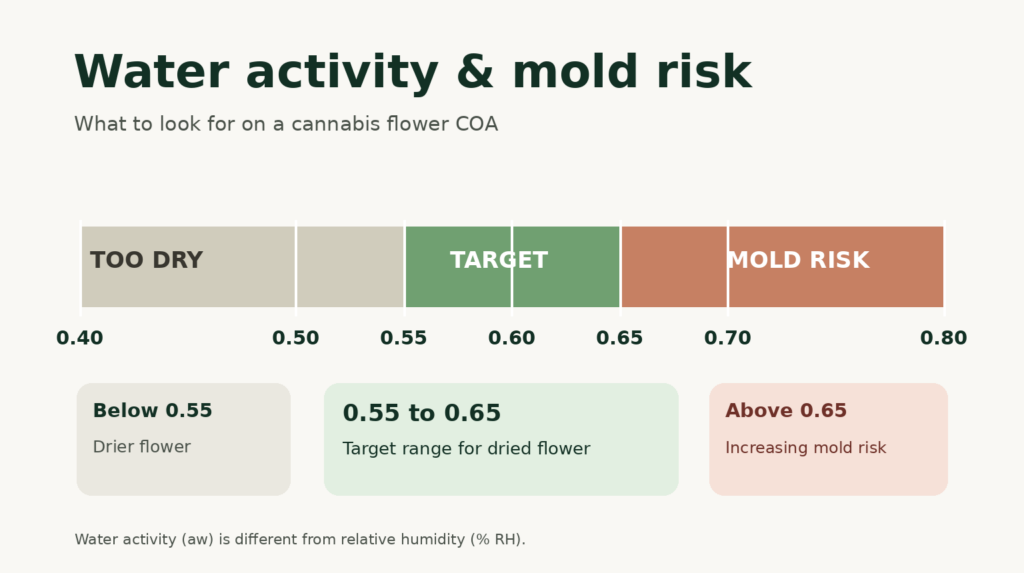
- Flower is also tested for water activity, and the industry standard range for dried flower is 0.55 to 0.65; above 0.65 is where mold risk climbs.
- If your cannabis looks moldy, don’t use it. Bring it back to the dispensary with the packaging and report it to OCM.
In February 2026, New York pulled 55 lots of cannabis off shelves. OCM said nobody had reported getting sick. The problem was the lab that tested them, which had been reporting results it couldn’t back up. Fifty-four of those lots were flagged for one thing: Aspergillus, a mold.
That’s a good reminder that mold is something the state actually checks for. It’s also a good reason to know how to check for yourself, because New York’s rules have a gap most people don’t know about: labs measure the total yeast and mold in flower, but the state doesn’t set a limit for it.
Below: how mold looks and smells up close, what New York labs check, the COA number that tells you how mold-prone a batch was, and what to do if your jar looks wrong.
What does moldy cannabis look like?
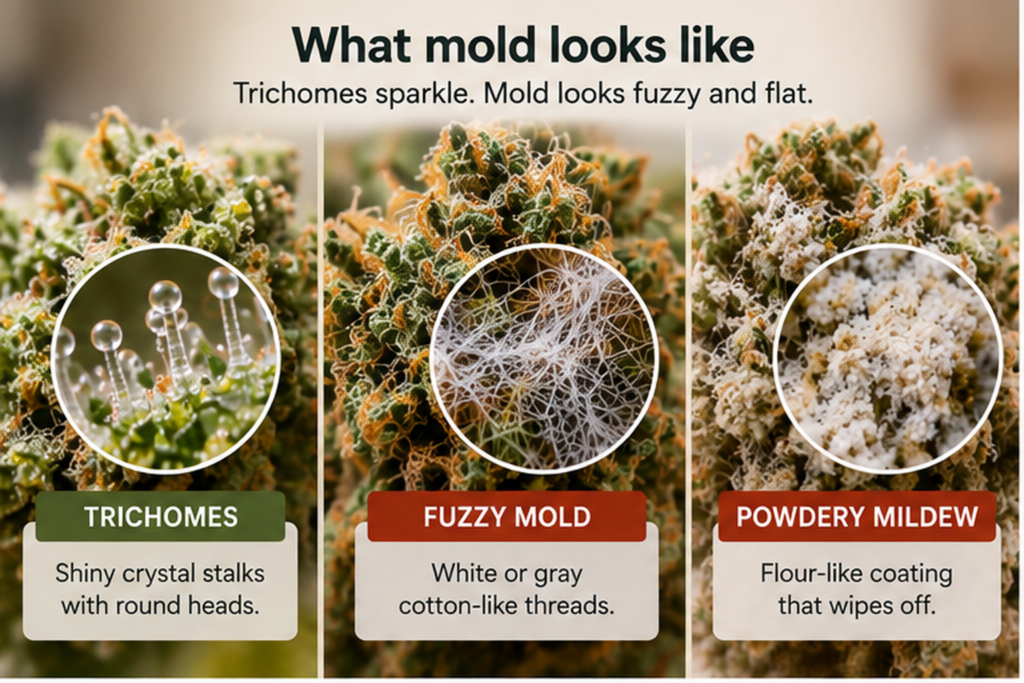
Moldy cannabis has fuzzy white or gray patches, brown or black spots, or a powdery coating that sits on top of the flower and doesn’t sparkle.
The easiest way to tell is light. Trichomes, the resin glands that cover good flower, catch light like little glass beads on stalks. Mold doesn’t catch anything. It’s flat and dull, like a cobweb or a smudge of dust.
There are three kinds you’re most likely to run into. Fuzzy mold looks like thin white or gray cotton. Powdery mildew looks like someone dusted the flower with flour, and when you rub it, it smears into a gray film. Bud rot (botrytis) is sneakier: it starts inside dense flower, so the outside can look fine while the middle has gone gray or brown and mushy.
If a piece looks suspicious, break it open. Then grab your phone, zoom the camera all the way in and look again. That takes about ten seconds and settles most questions.
| What you see | Looks like | When you touch it | Verdict |
|---|---|---|---|
| Trichomes | Shiny beads on tiny stalks | Sticky, resinous | Normal |
| Fuzzy mold | White or gray cotton threads | Dry, flat, no shine | Don’t use it |
| Powdery mildew | Flour dusted over the surface | Smears into a gray film | Don’t use it |
| Bud rot (botrytis) | Gray or brown mush inside the flower | Soft, damp, falls apart | Don’t use it |
What does moldy cannabis smell like?
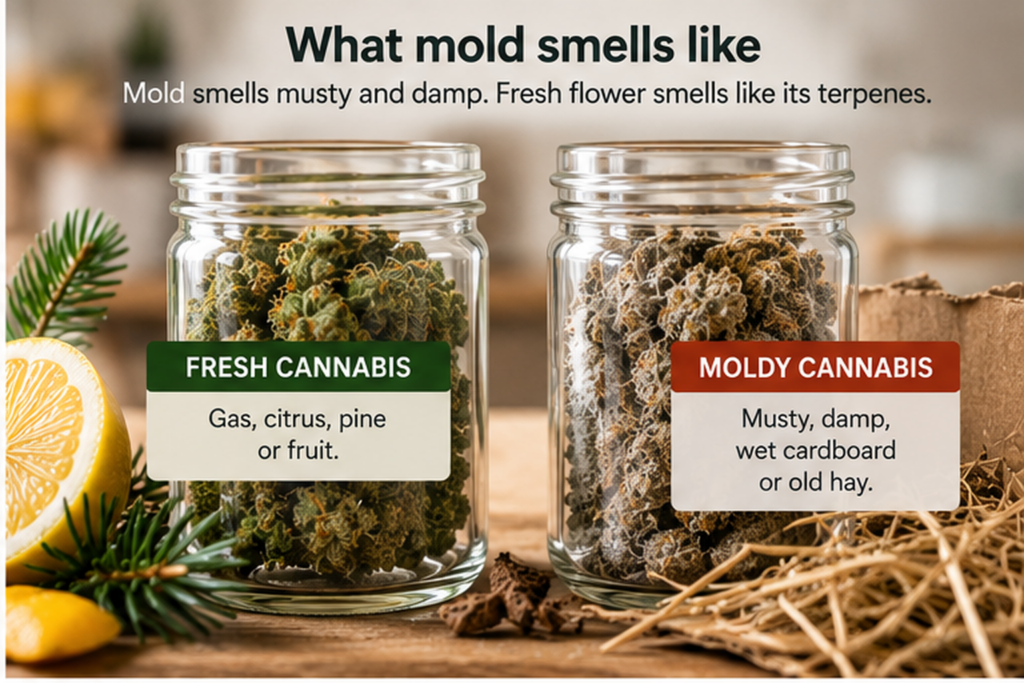
Moldy cannabis smells musty and flat, like a damp basement, wet cardboard or old hay. Good flower smells sharp and specific instead.
Fresh flower has a personality. Gassy strains smell like a gas station, citrus strains smell like peel, fruity ones smell like candy. Mold wipes all that out and leaves something flat and stale behind.
Think of the back of a closet in an old Staten Island house after a wet August. Musty, a little sour, nothing you’d want to breathe in on purpose. A hint of ammonia or rotting hay is another red flag, especially in flower that was packed before it was fully dry.
One thing that isn’t mold: flower that smells like nothing at all. That’s usually just old and dried out. Disappointing, but a different problem.
Does New York test cannabis for mold?
Yes. Labs test flower for total yeast and mold, harmful molds and mycotoxins, but OCM sets no limit for the total yeast and mold count.
Every licensed product in New York gets lab tested before it hits a shelf. For flower, the Office of Cannabis Management’s lab testing guidance requires microbiology and mycotoxin testing, a total yeast and mold count, a total aerobic bacteria count, moisture content, water activity, and a check for filth and foreign material.
What surprises people is that the same guidance says there’s no defined limit for total yeast and mold, or total aerobic bacteria, in flower. OCM calls total yeast and mold “a general quality indicator,” and says those numbers don’t necessarily tell you whether a harmful mold is present.
Harmful molds get their own tests, and the state takes them seriously. The February 27, 2026 recall of 55 product lots came after an audit found that Keystone State Testing New York had issued unreliable results: 54 lots for Aspergillus and one for cadmium. OCM called the recall precautionary and said it had no reports of anyone getting sick.
| Test on flower | Required in NY? | Is there a set limit? |
|---|---|---|
| Total yeast and mold | Yes | No; OCM calls it a quality indicator |
| Total aerobic bacteria | Yes | No |
| Microbiology (harmful organisms) | Yes | See the lab’s scope of testing |
| Mycotoxins | Yes | See the lab’s scope of testing |
| Water activity | Yes | Not set in the guidance; industry standard is 0.55 to 0.65 |
| Moisture content | Yes | Not set in the guidance |
What does water activity on a COA tell you about mold?
Water activity measures the free water mold can use. The industry standard for dried flower is 0.55 to 0.65, and above 0.65 mold risk climbs.
Most people skip right past this line, and it’s the most useful one for mold. Moisture content tells you how much water is in the flower overall. Water activity (written “aw”) tells you how much of that water is free for mold and bacteria to use.
ASTM International, the group that writes testing standards, publishes one for dried cannabis flower (D8197) that sets the acceptable range at 0.55 to 0.65. According to ASTM’s own write-up, 0.65 is widely treated as the ceiling before mold can grow, and below 0.50 the flower starts losing its terpenes, so the smell and flavor go flat.
So on a COA, a water activity in the 0.55 to 0.65 range is what you want to see. Higher than that and the batch was more mold-prone when it was tested.
Where is the mold section on a COA?
Look for the microbiology or microbial section. It lists total yeast and mold, aerobic bacteria and harmful molds, often as CFU per gram.
Scroll past the cannabinoid and terpene numbers. The mold info lives in its own section, usually labeled microbiology or microbial contaminants.
Total yeast and mold is reported in CFU/g, colony-forming units per gram. In plain terms, it’s how many living yeast or mold cells the lab could grow from one gram. Lower is cleaner. Since New York doesn’t set a limit, there may be no pass or fail next to it, so it’s worth comparing across the products you buy.
Harmful molds like Aspergillus are usually reported as detected or not detected. And check the test date: a COA from months ago tells you how the flower was then, not how it’s been stored since. Our COA guide covers the rest of the report.
How do you keep cannabis from getting moldy at home?
Keep it in an airtight glass jar somewhere cool and dark, and add a 58 or 62 percent humidity pack so the moisture stays in the right range.
Mold needs water and warmth, so take both away. A glass jar with a tight lid in a drawer or cabinet beats a plastic bag on a windowsill every time. Sun on a sealed jar turns it into a tiny greenhouse.
Two-way humidity packs (Boveda is one common brand) hold the air in the jar at a set humidity. The 58 and 62 percent packs line up with that 0.55 to 0.65 water activity range. A size 8 pack covers about an ounce.
Skip the fridge. Every time you take the jar out, the temperature change can cause condensation, and condensation is exactly what mold wants. Our cannabis storage guide goes deeper on jars and how long flower keeps.
What should you do if your cannabis looks moldy?
Don’t use it. Bring it back to the dispensary with the packaging so the lot can be traced, and report it through OCM’s incident form.
Don’t try to cut around the bad spot. Mold can reach further into the flower than you can see.
Bring it back to the licensed dispensary where you bought it, packaging and all, so the lot number can be traced.
Then report it to the state through OCM’s incident reporting page, under concerns with a cannabis product. It’s also worth checking OCM’s recalls page for your lot number.
Most people breathe in Aspergillus spores every day without a problem, but the CDC notes that people with weakened immune systems or lung disease are at higher risk of aspergillosis. If you feel unwell after using a product, call your doctor or the Poison Center at (800) 222-1222.
Frequently Asked Questions
Can cannabis get moldy?
Yes. Flower that was packed too wet or stored somewhere warm and humid can grow mold. A sealed glass jar, a cool dark spot and a humidity pack keep it in check.
What does moldy cannabis smell like?
Musty and flat, like a damp basement, wet cardboard or old hay. Good flower smells sharp and specific, so a stale, mildewy smell is the first warning sign.
How can you tell mold from trichomes?
Trichomes shine like little glass beads on stalks. Mold is dull and fuzzy or powdery, and it sits on top of the flower.
What water activity should cannabis have?
The ASTM standard for dried flower is 0.55 to 0.65. Above 0.65, mold risk goes up; below 0.50, the flower dries out and loses its smell.
Can you save moldy cannabis?
No. Cutting off the spot you can see doesn’t get the mold you can’t. Return it to the dispensary and report it to OCM.
Does New York test cannabis for mold?
Yes. Labs test flower for total yeast and mold, harmful molds and mycotoxins. OCM doesn’t set a limit for the total yeast and mold count, so check that number on the COA yourself.
If a jar ever looks or smells off, pull up its COA and find the water activity line before anything else. If it’s mold, bring it back.