Key Takeaways
- THCa (tetrahydrocannabinolic acid) is the form THC takes in raw cannabis, and on its own it doesn’t produce a high.
- Heat from a flame, a vaporizer or an oven turns THCa into delta-9 THC through a process called decarboxylation.
- New York law calculates total THC as THCa × 0.877 plus delta-9 THC, which is the total THC figure on a licensed COA.
- All cannabis flower is THCa flower; the term is a hemp-market label for cannabis sold under hemp rules, not a different plant.
- New federal hemp rules take effect December 11, 2026 and count THCa toward total THC; licensed dispensaries remain the legal source for THCa in New York.
Pick up any jar of flower at a New York dispensary and read the label. Alongside total THC, you’ll often find separate numbers for THCa and THC. Once you know what each number measures, you’ll know what’s in the jar and what changes when you heat it.
Read on to learn how to read those numbers on a New York label and how THCa compares to THC and CBD. We’ll also cover the federal change taking effect December 11, 2026, and how it could affect buying hemp THCa flower.
What is THCa?
THCa (tetrahydrocannabinolic acid) is the raw, unheated form of THC that cannabis plants make, and it turns into THC when it’s heated.
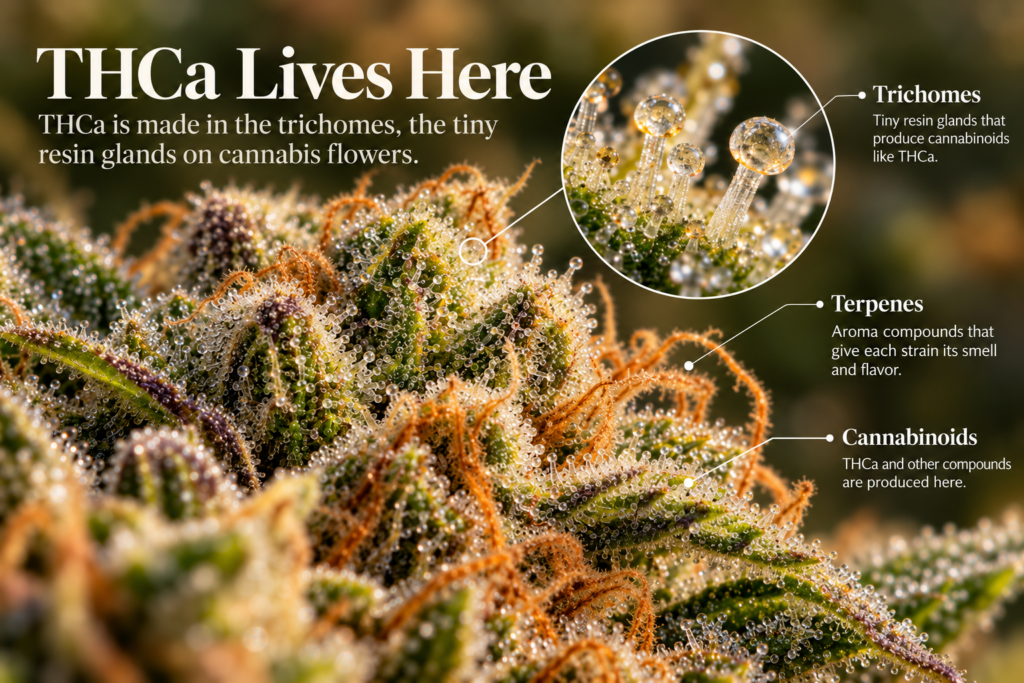
If you look closely at well-grown flower, you’ll see the frost, a coating of thousands of tiny resin glands called trichomes. Those glands are where the plant makes THCa. They also make terpenes, the compounds behind each strain’s smell. Depending on the strain, that smell might be sour gas, sweet citrus, or fresh pine.
The plant never makes THC directly. Instead, it makes THCa, an acid version of THC with one extra carboxyl group. That group is a small cluster of carbon and oxygen atoms, and as long as it stays attached, the compound remains THCa.
That’s why a raw-flower label often shows more THCa than THC. Since the flower hasn’t been heated yet, most of its THC is still in acid form. The total THC figure every New York label must show combines the two to estimate how much THC the flower will deliver once it’s lit.
Does THCa get you high?
Not in its raw form. THCa only produces a high after heat from a flame, a vaporizer, or an oven turns it into delta-9 THC.
Unlike THC, THCa doesn’t get you high on its own, so eating raw flower won’t do it either.
The change from THCa to THC is called decarboxylation, or decarbing. Heat breaks off THCa’s extra carboxyl group, and what’s left is delta-9 THC. The conversion happens quickly whether you smoke, vape, or bake, which is why cooking with cannabis starts with a decarb step. Smoking doesn’t convert all the THCa in the flower, though. In a lab study that simulated smoking, only about 30% of the THCa turned into THC.
THCa also converts slowly on its own as flower sits in storage, which is the next thing to know if you buy in bulk.
What happens to THCa as flower ages?
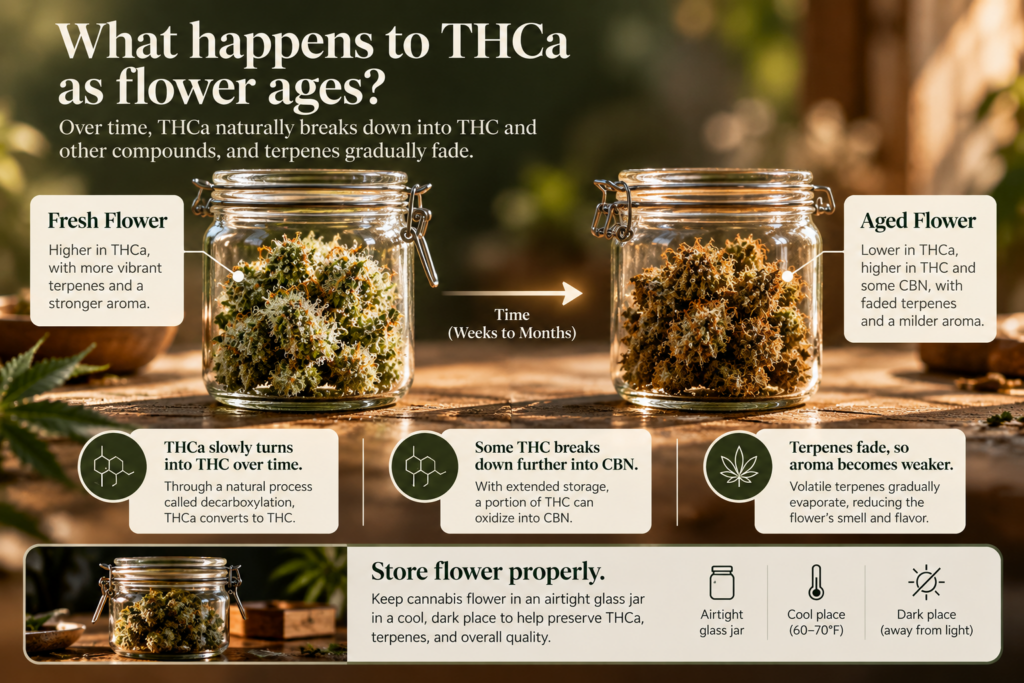
As months go by, the THCa and THC content of the flower you have will be different from the percentages printed on its label. The label shows lab results from before the flower was packaged, and the flower composition keeps changing after that.
Some of its THCa slowly turns into THC on its own, especially when the jar sits somewhere warm and bright. Over time, some of that THC breaks down further into CBN, a different cannabinoid. The terpenes fade during those same months, which is why a jar that smelled like lemon and diesel in spring can smell like hay by fall.
Good storage slows those changes down. The best practice is to keep your flower in an airtight glass jar, somewhere that’s cool and dark, away from the radiator and the windowsill. Our cannabis storage guide covers jars, humidity packs, and how long flower keeps.
At the shop, flower sits in humidity-controlled storage and concentrates stay refrigerated. That way, what you take home matches its COA (certificate of analysis, the lab report listing the product’s cannabinoid content) as closely as possible.
What’s the difference between THCa and THC?
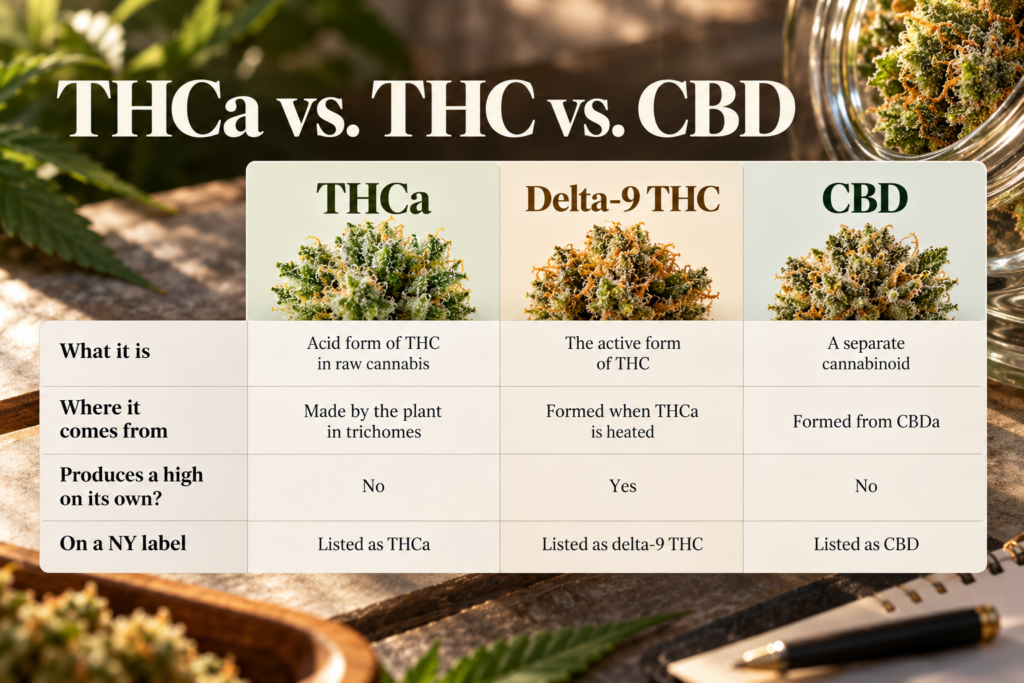
THCa is the acid form found in the raw plant and THC is what it becomes after heating; labels list both, and total THC combines them.
THCa is THC before the heat hits it. Both come from the same trichomes, and one turns into the other. So is THCa the same as THC? Chemically, no; once it’s heated, it becomes THC.
Delta-9 THC is the specific form of THC that licensed New York products are tested for. When a label just says THC, that’s what it means. CBD is a different cannabinoid altogether; our CBD vs THC guide covers that split.
What is THCa flower, and is it different from dispensary flower?
All cannabis flower is THCa flower. The term is a blanket hemp-market label for cannabis sold under hemp rules, not a different kind of plant.
The Agriculture Improvement Act of 2018, commonly called the 2018 Farm Bill, defined hemp by its delta-9 THC content alone. Under those rules, flower could be sold as hemp as long as its delta-9 THC tested low. It didn’t matter how much THCa the flower carried, even though that THCa turns into THC once it’s heated. That gap is where “THCa flower” came from as a product category.
The plant is the same, but the rules it’s grown and sold under are different. Flower from a licensed New York dispensary is grown and processed by state-licensed operators and tested by state-licensed labs. Every product comes with a COA (certificate of analysis) that lists THCa, delta-9 THC, and total THC.
When someone asks us whether THCa flower is the same as regular cannabis, we say yes. Then we ask where it was grown, how it was tested, and which rules it was sold under.
Is THCa legal in New York?
Yes, at licensed dispensaries for adults 21 and up. Hemp THCa flower is a different story, and federal rules tighten on December 11, 2026.
Cannabis from a licensed New York dispensary, THCa included, is legal for adults 21 and older with a valid ID. You don’t need a medical card. The state’s consumer page covers the basics, and our New York cannabis laws guide covers possession limits and where you can consume.
Hemp is regulated separately. New York’s cannabinoid hemp rules cap delta-9 THC at 0.3% and don’t allow hemp products to be sold in forms associated with smoking, like pre-rolls, according to the Office of Cannabis Management’s hemp overview.
The federal rules are changing too. Public Law 119-37, signed November 12, 2025, rewrote the federal definition of hemp: finished hemp products can’t contain more than 0.4 milligrams of total THC per container, and THCa counts toward that total. A stopgap funding bill moved the effective date to December 11, 2026.
As of October 2026, that means hemp THCa flower loses its federal cover in December, while licensed cannabis stays exactly where it is.
| Licensed NY cannabis | Hemp sold in New York | Federal hemp from Dec 11, 2026 | |
|---|---|---|---|
| Who regulates it | NY Office of Cannabis Management | NY Office of Cannabis Management (hemp program) | Federal law (Public Law 119-37) |
| THC rule | Tested and labeled; total THC shown | Max 0.3% delta-9 THC | Max 0.4 mg total THC per container, THCa included |
| Smokable forms | Allowed for adults 21+ | Not allowed (e.g., pre-rolls) | Products over the cap aren’t hemp |
| Where to buy | Licensed dispensaries | Licensed hemp retailers | n/a |
How do you read THCa on a COA?
Locate the THCa and delta-9 THC lines. New York calculates total THC as THCa × 0.877 plus delta-9 THC, and that’s the total on the label.
Every licensed product in New York ships with a COA, the lab report behind the label. In the cannabinoid section you’ll see THCa and delta-9 THC listed separately, then a total THC line.
The math comes straight from New York Cannabis Law § 3, which defines total THC as the THCa percentage multiplied by 0.877, plus the delta-9 THC percentage.
Why 0.877? When THCa turns into THC, it loses its carboxyl group as carbon dioxide, and that piece is about 12.3% of the molecule’s weight. Multiplying by 0.877 gives you the THC that THCa can actually become.
Here’s a made-up example: a COA showing 10% THCa and 0.5% delta-9 THC works out to 10 × 0.877 + 0.5 = 9.27% total THC. That total is the figure New York uses. Our guide on how to read a cannabis COA walks through the rest of the report, from terpenes to contaminant testing.
Frequently Asked Questions
Does THCa get you high?
Not when it’s raw. THCa needs heat to become delta-9 THC, the compound that produces a high. A flame, a vaporizer or an oven does the conversion.
Is THCa the same as THC?
No, but one becomes the other. THCa is the acid form in raw cannabis, and heating it turns it into delta-9 THC. Labels list both, and total THC combines them.
Is THCa legal in New York?
Yes, in licensed cannabis products sold to adults 21 and up at state-licensed dispensaries. Hemp products have separate rules, and federal hemp limits that count THCa take effect December 11, 2026.
Does THCa show up on a drug test?
Standard drug tests look for THC and what your body makes from it. Heating THCa turns it into THC, so treat THCa flower the same as any cannabis if you’re subject to testing, and check your employer’s policy.
What’s the difference between THCa and delta-9 THC?
THCa is the raw acid form, and delta-9 THC is the active form it becomes after heating. Delta-9 THC is what New York labs report as THC.
What’s the difference between THCa and CBD?
They’re separate cannabinoids. THCa becomes THC when heated, and CBD comes from a different acid, CBDa. CBD doesn’t produce a high.
Next time you’re reading a label at our Forest Ave shop, look for the THCa line, then the total. The THCa line is the raw number, and the total is what it becomes.