Key Takeaways
- Delta-9 THC is the main intoxicating compound in cannabis, and it’s the THC in products licensed New York dispensaries sell.
- Delta-8 THC shows up naturally only in tiny amounts, so nearly all delta-8 for sale is made by chemically converting hemp-derived CBD.
- New York’s hemp rules don’t allow semi-synthetic cannabinoids like delta-8 and delta-10 in hemp products, and haven’t since 2021.
- In a 2022 University at Buffalo survey, delta-8 users described it as a milder version of delta-9.
- Federal hemp rules are changing: hemp products with more than 0.4 mg of total THC per container lose hemp status, with key parts starting December 11, 2026.
You’ve probably seen “delta-8” on a counter somewhere around the city. The label says THC, so is it the same thing as what’s in a jar at a dispensary?
Short answer: no. Delta-9 is the THC the cannabis plant makes, and it’s what licensed New York dispensaries sell. Delta-8 is a close cousin that’s almost always made in a lab from hemp CBD, and New York has kept it out of hemp products since 2021. Below is how the two compare, what’s legal here and how to check what’s in your product.
What’s the difference between delta-9 and delta-8 THC?
Delta-9 and delta-8 are nearly identical THC molecules. Delta-9 is what cannabis makes; most delta-8 for sale is converted from hemp CBD.
Chemically, the two are almost twins. The only difference is where one double bond sits in the molecule: on the 9th carbon for delta-9, the 8th for delta-8. That small shift is enough to change how strongly each one affects you.
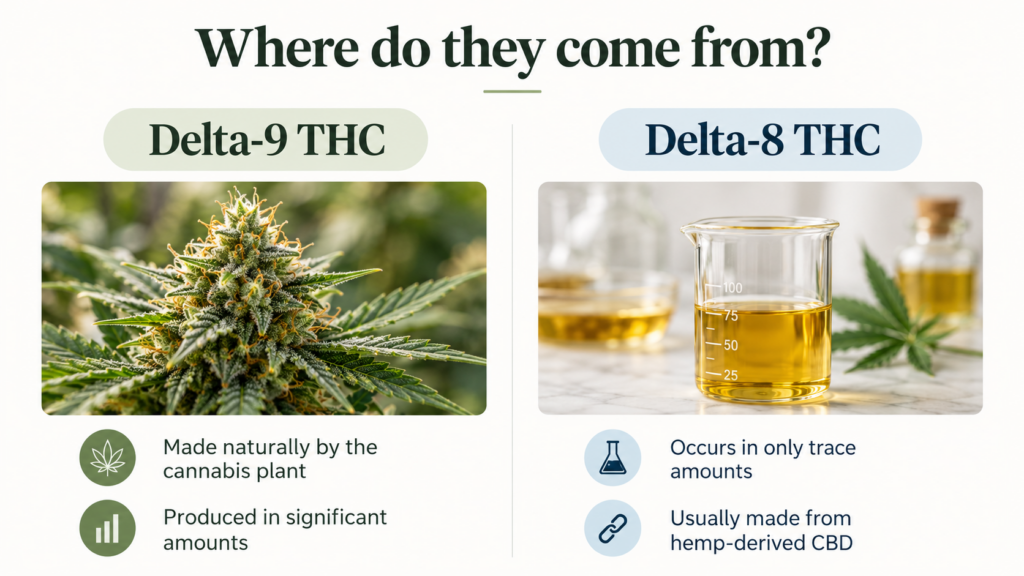
The bigger difference is where they come from. The cannabis plant makes plenty of delta-9 (by way of THCA, more on that below). It makes only trace amounts of delta-8, so the delta-8 you see for sale is almost always made from CBD.
If you’re comparing delta 8 vs delta 9 on a shelf, the table sums it up.
| Delta-9 THC | Delta-8 THC | |
|---|---|---|
| Where it comes from | Made by the cannabis plant | Trace amounts in the plant; most is converted from hemp CBD |
| How it feels | The full effect most people mean by “THC” | Described as milder by users in a 2022 survey |
| In New York hemp products | Allowed up to 0.3% by dry weight | Not allowed since 2021 |
| At licensed NY dispensaries | Yes | No |
| On a COA | Listed as Δ9-THC, plus THCA and Total THC | Shows up only if the lab tests for it |
What is delta-9 THC?
Delta-9 THC is the main intoxicating compound in cannabis. When people just say “THC” on a label or menu, delta-9 is the one they mean.
So if you’ve searched “delta 9 vs THC,” they’re the same thing. Delta-9 tetrahydrocannabinol is the compound behind the classic cannabis effect, and it’s what labels and lab reports mean by THC.
A living plant barely makes delta-9 directly, though. It makes THCA, which doesn’t do much on its own. Heat changes THCA into delta-9, which is why flower gets lit, vaped or baked.
Comparing THC with CBD instead? Our CBD vs THC guide covers that one.
What is delta-8 THC, and where does it come from?
Delta-8 forms naturally only in trace amounts, so nearly all the delta-8 you see for sale is made by chemically converting CBD from hemp.
Since the plant barely makes delta-8, producers start with CBD extracted from hemp and use chemicals to rearrange it into delta-8. That process is called isomerization, and it’s why regulators call delta-8 “semi-synthetic.”
The FDA’s consumer update on delta-8 says the natural amount in hemp is very low and that extra chemicals are needed to convert CBD into delta-8. The FDA also notes delta-8 has psychoactive and intoxicating effects similar to delta-9. [COMPLIANCE: counsel to confirm this paragraph reads as neutral fact, not disparagement, under Part 129 (a)(19).]
Delta-10 works the same way: another lab-made rearrangement of THC that New York treats the same as delta-8.
Is delta-8 or delta-9 stronger?
Delta-9 has the stronger effect. In a 2022 survey of 521 delta-8 users, people described delta-8 as a milder version of delta-9.
The best-known survey on this comes from researchers Jessica Kruger of the University at Buffalo and Daniel Kruger of the University of Michigan. They asked 521 delta-8 users from 38 states, and 29 percent of them were New Yorkers.
Respondents called delta-8 delta-9’s “nicer younger sibling.” Most said they could go about their day, and they rated paranoia and anxiety between “not at all” and “a little,” per the University at Buffalo’s summary.
That’s one self-reported survey, not a lab comparison. What you’ll feel from any THC product depends on how much you have, how you take it and your own tolerance.
Is delta-8 legal in New York?
Not in hemp products. New York has kept delta-8 out of hemp products since 2021, and licensed dispensaries sell delta-9 THC instead.
New York’s Cannabis Control Board approved its hemp rules on November 3, 2021, and they shut delta-8 out of the state’s hemp program. The Office of Cannabis Management’s 2026 hemp overview says New York cannabinoid hemp products “cannot contain semi-synthetic or isomerized cannabinoids, such as delta-8 THC or delta-10 THC.”
The same rules cap delta-9 in hemp products at 0.3 percent and don’t allow smokable hemp like pre-rolls or cigars. [CONFIRM: John or NugHub’s compliance contact to approve this legal wording.]
Federal rules are changing too. A November 2025 law rewrote the federal definition of hemp to count total THC, and hemp products with more than 0.4 mg of THC and similar cannabinoids per container lose hemp status. According to the Congressional Research Service, some parts take effect November 12, 2026 and others were pushed to December 11, 2026. Our New York cannabis laws guide has the rest of the state rules.
As of October 21, 2026. We’ll update this section after the federal changes take effect.
| New York | Federal | |
|---|---|---|
| Who sets the rule | Office of Cannabis Management and Cannabis Control Board | Congress (hemp definition) |
| Delta-8 in hemp products | Not allowed since Nov 3, 2021 | Counts toward the 0.4 mg per-container limit |
| THC limit for hemp | 0.3% delta-9 by dry weight | 0.3% total THC; 0.4 mg per container for final products |
| When | In force now | Parts start Nov 12, 2026; others Dec 11, 2026 |
What THC do New York dispensaries actually sell?
Licensed New York dispensaries sell delta-9 THC, plus THCA flower that turns into delta-9 when heated, all grown and tested in New York.
Walk into a licensed shop like ours on Forest Ave and the THC on the shelf comes from cannabis grown, processed and lab tested in New York. That’s flower, pre-rolls, vapes, edibles and concentrates.
Flower labels list THCA and Total THC, since the THC is still in its THCA form until you heat it. Vapes, edibles and concentrates list delta-9 THC, because the heat already happened during processing.
Lab-tested, licensed THC: see our flower guide.
| Product | Form of THC | What the label shows |
|---|---|---|
| Flower and pre-rolls | Mostly THCA, which becomes delta-9 when lit | THCA and Total THC |
| Vapes | Delta-9 | Δ9-THC |
| Edibles | Delta-9 | Δ9-THC per serving and per package |
| Concentrates | Delta-9 and THCA, depending on the product | Δ9-THC, THCA and Total THC |
How can you tell which THC is in your product?
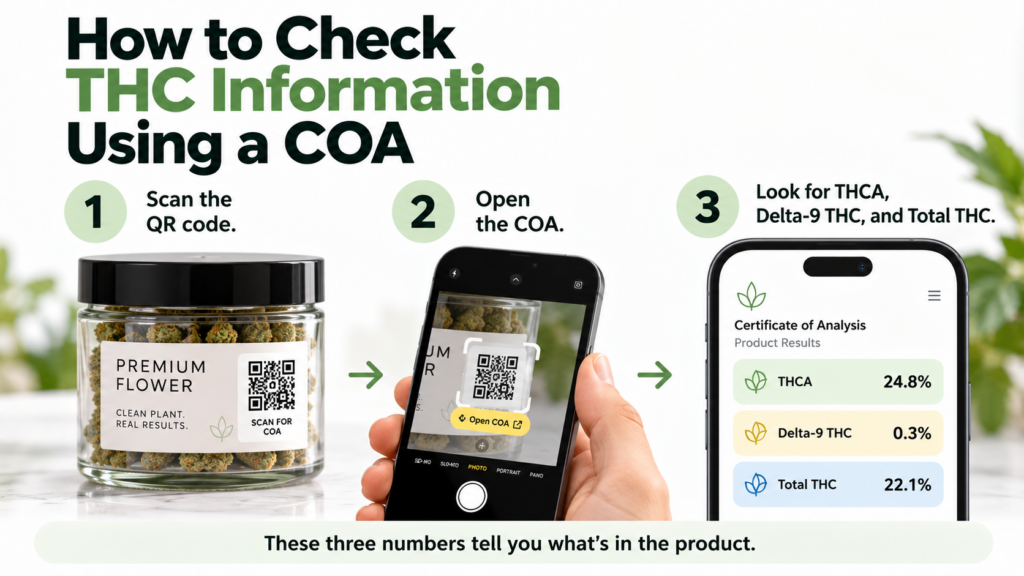
Check the product’s COA, the lab report behind the label. It lists Δ9-THC, THCA and Total THC, plus delta-8 if the lab tested for it.
Every licensed product in New York comes with a COA (certificate of analysis), the lab report behind the label. Look for three lines: Δ9-THC, THCA and Total THC.
Total THC is the number that tells you what you’ll get once it’s heated. Labs calculate it as THCA × 0.877 + Δ9-THC, since THCA loses a little weight when it converts. Our guide to reading a cannabis COA walks through the full report.
THCA vs delta-9
THCA is the raw form the plant makes. Heat turns it into delta-9. They’re the same THC at different stages, which is why flower labels show both.
Delta-9 vs delta-10
Delta-10 is another lab-made rearrangement, like delta-8. New York treats it the same way and doesn’t allow it in hemp products.
“Hemp-derived delta-9”
That’s the same delta-9 molecule, sold under hemp rules with the 0.3 percent limit instead of through a licensed dispensary. Products from a licensed New York dispensary come from licensed adult-use cannabis growers.
Frequently Asked Questions
Is delta-8 real cannabis?
Delta-8 comes from cannabis, but most of it is made in a lab by converting hemp CBD. The plant itself makes delta-9, by way of THCA.
Can you buy delta-8 at a New York dispensary?
No. Licensed New York dispensaries sell delta-9 THC and THCA flower. New York doesn’t allow delta-8 in hemp products either.
Is delta-9 legal in New York?
Yes. Adults 21 and older can buy delta-9 THC products at licensed New York dispensaries.
Is hemp-derived delta-9 the same as dispensary delta-9?
It’s the same molecule, sold under different rules. Hemp products are capped at 0.3 percent delta-9; dispensary products come from licensed adult-use growers.
Is THCA legal in New York?
Yes, at licensed dispensaries. THCA flower is sold as cannabis, and its label shows THCA and Total THC.
Do you need a medical card to buy THC in New York?
No. If you’re 21 or older with a valid ID, you can shop at a licensed dispensary like NugHub on Forest Ave or order delivery.
Next time you’re comparing labels, flip to the COA. If you see Δ9-THC, THCA and Total THC from a licensed New York lab, you know exactly what you’re getting.